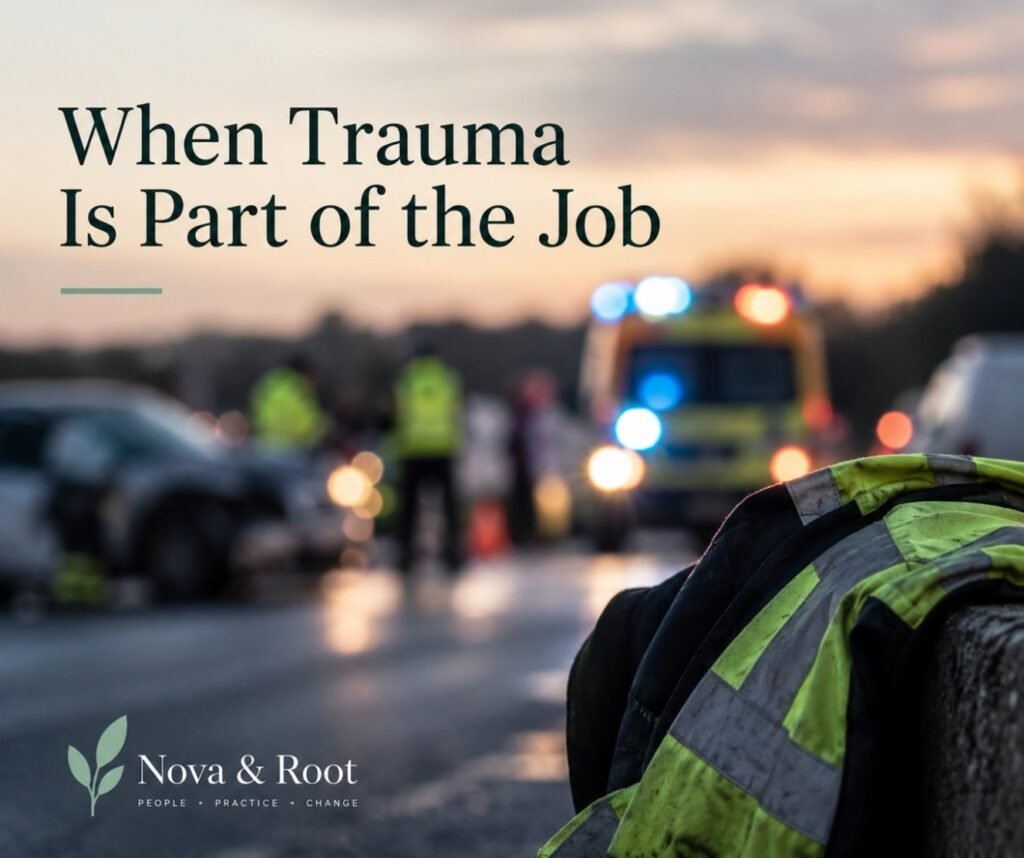
Something recently written about suicide amongst police officers raises a difficult but important question about the impact of trauma at work.
For anyone who has spent time working inside a police station, there are things that are difficult not to notice.
Officers can come back from jobs most people would struggle to imagine, make a cup of tea, have a joke with a colleague and move straight onto the next thing.
There can be an enormous amount being carried.
And very little being said about it.
The same can be seen across many trauma-exposed professions.
People often choose this work because they care.
They become police officers because they want to protect people.
They become paramedics because they want to help.
They work in safeguarding because they want children and adults to be safer.
They go into sexual violence, domestic abuse, social work, healthcare, prosecution and countless other professions because somewhere underneath the qualifications, policies and job descriptions, there is usually a person who gives a damn about other people.
And perhaps we don’t talk enough about the cost of that.
People become very good at carrying things
Inside a police station, one of the things that becomes apparent very quickly is how normal the abnormal can become.
Something incredibly difficult happens and the day doesn’t stop.
There is another call.
Another incident.
Another person waiting.
Another piece of work that needs doing.
So people learn to carry it.
Sometimes with humour.
Sometimes by talking to colleagues.
Sometimes by saying absolutely nothing at all.
And from the outside, that can look like resilience.
But being able to continue functioning doesn’t necessarily mean somebody is unaffected.
Sometimes it simply means they have become exceptionally good at carrying things quietly.
Culture teaches people what they are allowed to say
An organisation can have the best wellbeing policy in the world.
It can have an EAP (Employee Assistance Programme).
It can train Mental Health First Aiders.
It can tell people that it’s okay not to be okay.
But what does the actual culture say?
What happens when somebody says:
That job really affected me.
I need a break.
I don’t think I can take another one today.
I’m struggling.
Are they supported?
Or do they quickly learn that everyone else seems to be coping, so perhaps they should too?
Culture isn’t what is written in a wellbeing policy.
It’s what people learn is safe to say when nobody is reading the policy.
And that is something organisations need to be willing to look at properly.
If trauma is part of the job, review the job
Organisations need to move beyond conversations about individual resilience.
If an organisation knows that people are routinely exposed to trauma through their work, that exposure should be considered in how the work itself is designed.
Not after someone reaches breaking point.
Before.
That means looking at repeated exposure to traumatic material or incidents.
How work is allocated.
Whether the same people repeatedly take the most difficult cases.
Caseloads and workloads.
What happens after a particularly difficult incident.
Whether there is actual recovery time, rather than somebody being expected to move immediately onto the next thing.
The quality and frequency of supervision.
Whether managers know what their teams are being exposed to.
Sickness and turnover patterns.
Exit interviews.
Whether people are using wellbeing support and perhaps more importantly, why some teams aren’t.
And whether staff genuinely believe that asking for help is safe.
There are interesting developments happening in policing around this. The College of Policing has published work on trauma trackers that record exposure to potentially traumatic incidents, precisely because that exposure can otherwise go unnoticed. The intention isn’t to diagnose somebody. It’s to give supervisors information that can start earlier conversations and inform decisions about workload and wellbeing.
The thinking behind that is important.
Don’t only measure the outcome. Pay attention to the exposure.
And don’t wait for people to tell you
The people who care deeply don’t always put their hand up.
Sometimes they’re the ones who stay late.
Take the extra case.
Answer the phone.
Cover the shift.
Tell everyone else they’re fine.
They might be the person everyone describes as resilient.
That’s why organisations cannot build their approach around waiting for people to ask for help.
By then, months or years of opportunities to notice may already have been missed.
At Nova & Root, becoming trauma-informed means looking beyond individual coping strategies.
Not another wellbeing session.
Not teaching already stretched people another technique for coping with an environment the organisation hasn’t examined.
Sometimes the work needs to be with the organisation itself.
Look at the culture.
Look at supervision.
Look at workload and allocation.
Look at policies alongside what actually happens in practice.
Look at where responsibility sits.
Look at whether managers have the skills, capacity and permission to notice.
Talk to the people doing the work.
Ask what they carry that nobody sees.
And then be prepared to change something.
Because a trauma-informed organisation isn’t one where nobody experiences trauma.
In some professions that would be impossible.
It’s an organisation that understands exposure has an impact and takes responsibility for the conditions around it.
People go into these jobs because they care.
Organisations shouldn’t allow that care to become the reason people are expected to carry more and more until eventually they can’t.
If trauma is part of the job, then understanding it, noticing it and responding to it needs to be part of the job too.
Stay connected
Sign up for our newsletter. New articles, resources, and insights sent with care. No spam, unsubscribe anytime.