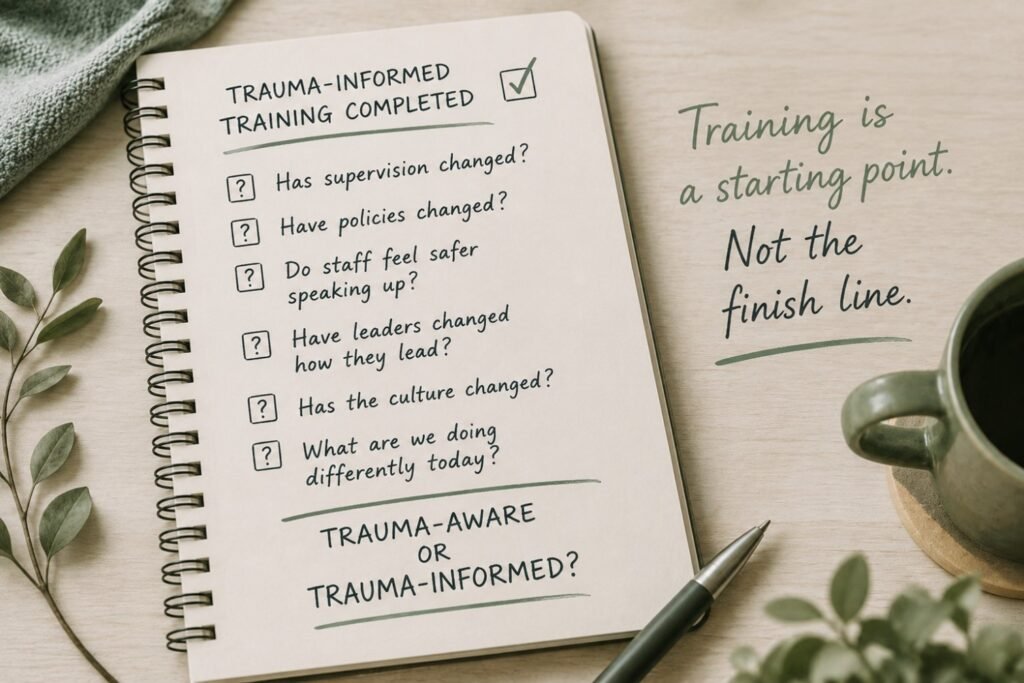
Over the past few years, I’ve noticed a significant increase in organisations describing themselves as trauma-informed.
On one level, that’s encouraging.
It means conversations about trauma, adversity, wellbeing, and psychological safety are becoming more common. More leaders are recognising that people’s experiences don’t stop at the workplace door, and that trauma can influence how individuals think, feel, relate to others, and engage with services.
But there is a question I find myself asking more and more:
Are we truly trauma-informed, or are we simply trauma-aware?
The distinction matters.
Being trauma-aware means we understand that trauma exists. We may have attended training, read articles, listened to speakers, or introduced trauma-informed language into our policies and conversations.
Awareness is an important first step.
But it is only the beginning.
Trauma-informed practice requires something much harder.
It requires us to change how we work.
I often meet organisations that have invested in excellent training. Staff leave feeling inspired, motivated, and committed to doing things differently. Yet six months later, many of the systems, processes, and cultures remain unchanged.
The language has shifted.
The practice has not.
An organisation does not become trauma-informed because its staff attended a training course.
It becomes trauma-informed when the learning influences everyday decisions.
When leaders communicate with transparency during difficult periods.
When mistakes become opportunities for learning rather than blame.
When policies are reviewed through a lens of safety, trust, choice, collaboration, and empowerment.
When supervision creates space for reflection rather than simply monitoring performance.
When wellbeing is considered in workload discussions, not just wellbeing weeks.
When people feel able to raise concerns without fear of negative consequences.
Trauma-informed practice is not something we deliver.
It is something we embed.
And that can feel uncomfortable.
Because genuine trauma-informed change often requires organisations to look inward.
To ask difficult questions.
Do our systems create psychological safety?
Are our values reflected in our behaviours?
Do people feel heard?
Do our processes support healing and growth, or do they unintentionally create barriers, fear, or shame?
These are not always easy conversations.
But they are necessary ones.
Perhaps one of the biggest misconceptions is that becoming trauma-informed is a destination.
A certificate.
A training programme.
A box to tick.
In reality, it is an ongoing commitment to learning, reflection, and improvement.
No organisation gets it right all of the time.
The goal is not perfection.
The goal is curiosity.
A willingness to keep asking whether our environments help people feel safe, respected, valued, and able to thrive.
So perhaps the question is not:
“Are we trauma-informed?”
But rather:
“What are we doing differently because we understand the impact of trauma?”
The answer to that question often tells us far more than any policy, training certificate, or statement on a website ever could.
Reflection:
Trauma-aware organisations understand trauma exists. Trauma-informed organisations change the way they work because of it
Stay connected
Sign up for our newsletter — new articles, resources, and insights sent with care. No spam, unsubscribe anytime.