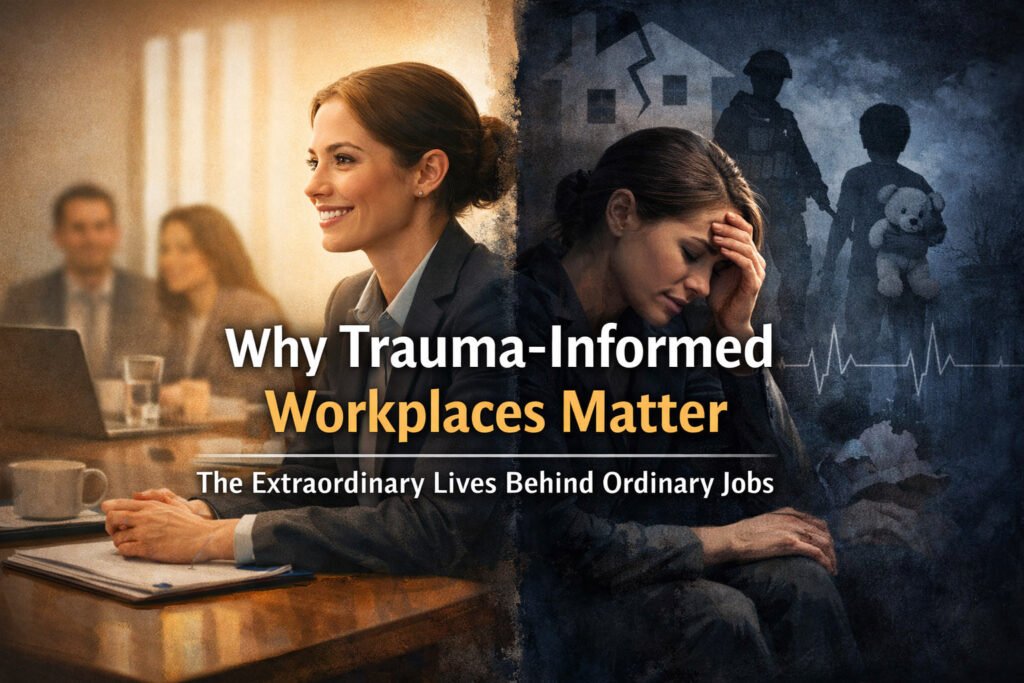
The Extraordinary Lives Behind Ordinary Jobs.
I’ve chaired meetings while quietly trying to steady my breathing.
From the outside it looked like leadership. Calm, composed, professional.
Inside, my nervous system was doing something very different reminding itself that the room was safe.
Over the years, both through my work and my own life, I’ve come to understand something that doesn’t get spoken about enough.
Many of us are living ordinary lives while carrying extraordinary experiences.
Trauma is far more common than we like to admit. Loss, violence, neglect, instability, grief, discrimination, fear, sudden life changes, these experiences shape how our nervous systems learn to navigate the world. They influence how we trust, how we react under pressure, how safe we feel in relationships, and how we cope with stress.
Yet the environments we work in rarely acknowledge this reality.
Instead, workplaces are often built around an expectation that people arrive each day as fully regulated, endlessly resilient individuals who can perform consistently regardless of what they carry with them.
But human beings do not operate like machines.
The quiet performance of “being fine”
For many people, work involves a quiet kind of performance.
Smile at the right time.
Run the meeting.
Respond quickly to emails.
Stay calm under pressure.
Deliver results.
On the outside, it can look like competence, professionalism, and productivity.
On the inside, however, there can be a completely different process happening.
People may be managing anxiety, intrusive memories, exhaustion, grief, or the lingering effects of past experiences that shaped how their nervous system responds to stress.
I’ve experienced this myself. There have been moments where I’ve led meetings, facilitated discussions, or delivered training while simultaneously trying to steady my own internal responses. Not because I wasn’t capable but because our bodies don’t simply switch off the impact of our experiences when we step into professional spaces.
And I know I am not alone in this.
Many people are navigating their lives with incredible strength and quiet resilience, even when no one around them realises it.
The misunderstanding of resilience
In many workplaces, resilience is often misunderstood.
We praise people for pushing through, working longer hours, staying composed under pressure, and managing large workloads without complaint.
But resilience is not simply endurance.
True resilience is supported by safety, trust, understanding, and environments where people feel psychologically secure enough to speak honestly about their needs.
The problem is not that people are fragile.
The problem is that many workplaces are designed as if people have never been hurt.
When organisations overlook the emotional and psychological realities people bring with them, they unintentionally create environments where individuals feel they must hide vulnerability, suppress stress, and continue performing until they reach burnout.
Trauma doesn’t stay at home
One of the most important principles of trauma-informed thinking is recognising that people do not leave their life experiences at the door when they come to work.
A difficult childhood, experiences of violence, discrimination, systemic inequalities, caring responsibilities, grief, or previous workplace harm all shape how individuals interact with authority, pressure, and relationships.
This does not mean people are fragile or incapable.
In fact, many of the people carrying the most difficult histories are also those demonstrating remarkable empathy, commitment, and leadership.
What it does mean is that workplaces must recognise the invisible labour many people are already doing simply to function in environments that were never designed with trauma in mind.
What trauma-informed workplaces do differently
Becoming trauma-informed is not about lowering standards or removing accountability. It is about creating environments where people can perform well without sacrificing their wellbeing.
Some practical shifts organisations can make include:
1. Creating psychological safety
Leaders who encourage openness, listen without judgement, and acknowledge human complexity allow staff to feel safer expressing challenges before they escalate. People should not feel that asking for support will cost them their reputation or their career.
2. Improving communication and transparency
Clear expectations, consistent messaging, and predictable structures help reduce uncertainty — something that can be particularly difficult for people whose nervous systems are sensitive to stress.
3. Recognising signs of distress rather than labelling behaviour
Instead of viewing withdrawal, irritability, or overwhelm as poor performance, trauma-informed leaders ask a different question: What might this person be experiencing right now?
4. Building supportive supervision and reflective spaces
Regular, meaningful check-ins allow staff to process difficult work and maintain emotional balance.
5. Embedding wellbeing into organisational culture
Not as an occasional initiative, but as a sustained commitment to healthy workloads, supportive leadership, and realistic expectations.
The leadership responsibility
Leaders play a particularly important role in shaping trauma-informed cultures.
When leaders model compassion, acknowledge their own humanity, and create space for honest conversations, they send a powerful message: people do not have to perform perfection in order to belong.
Workplaces become healthier when we recognise that strength and vulnerability are not opposites — they exist side by side.
Moving forward
Most organisations genuinely want their staff to thrive.
But good intentions alone are not enough. Without awareness of trauma and its impact, systems can unintentionally reinforce pressure, silence, and isolation.
Trauma-informed practice invites us to pause and ask a different set of questions:
What might people be carrying that we cannot see?
How can we design environments that support regulation, trust, and dignity?
What would it look like to lead with understanding as well as performance expectations?
These questions matter because when people feel safe enough to be human at work, organisations benefit too.
Creativity improves. Collaboration deepens. Retention increases. People feel valued not just for what they produce, but for who they are.
A shared responsibility
At Nova & Root, we work with organisations that want to explore this shift — supporting leaders and teams to build trauma-informed cultures that recognise the realities people bring into professional spaces.
Because behind every role, every title, and every workplace interaction is a human being with a story.
And sometimes the most extraordinary thing someone does at work that day is simply showing up.
Stay connected
Sign up for our newsletter. New articles, resources, and insights sent with care. No spam, unsubscribe anytime.