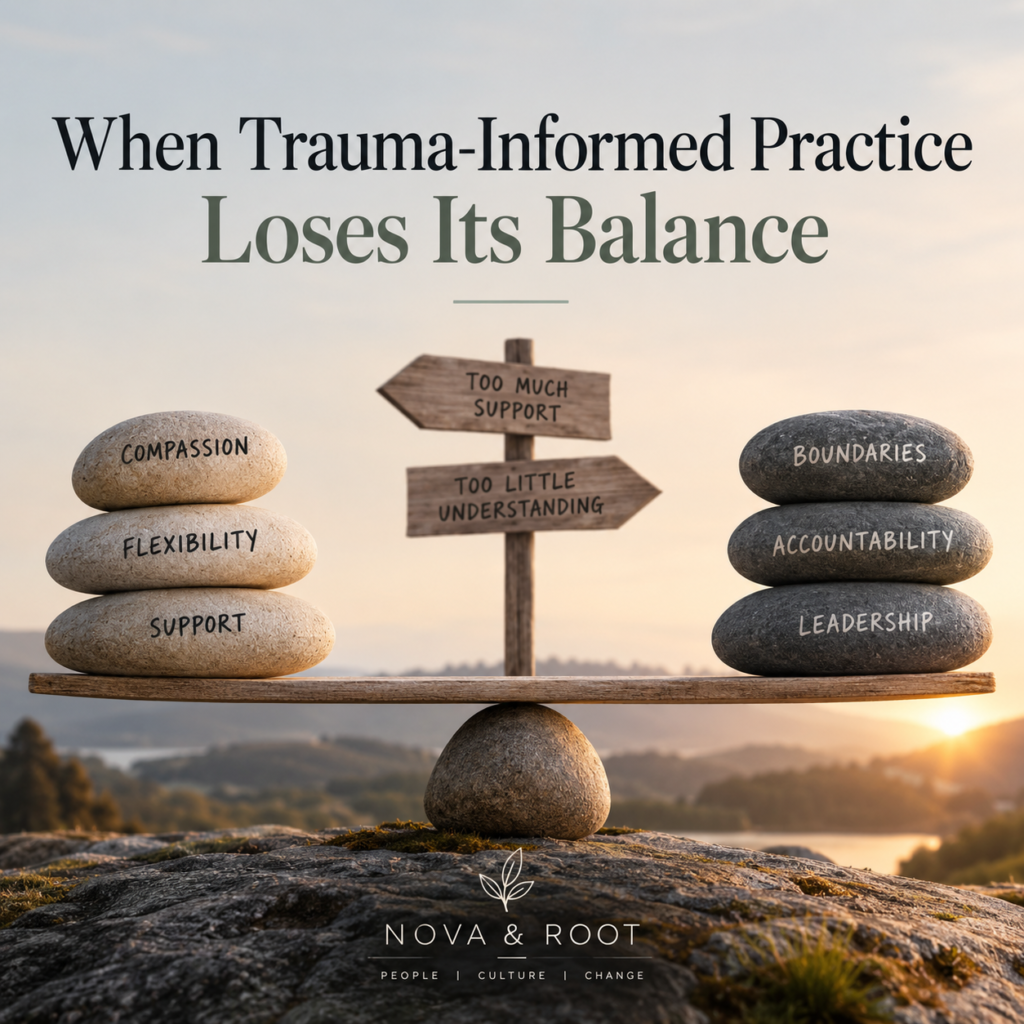
There is something I think we need to talk about more when we talk about trauma-informed organisations.
The extremes.
On one side, we have organisations where policy is policy, hierarchy is rarely questioned, performance comes before people and there is very little curiosity about what might be sitting underneath someone’s behaviour.
We have become quite good at recognising why that isn’t trauma-informed.
But there is another extreme that I think we talk about far less.
The organisation that becomes so focused on being understanding, flexible and supportive that it becomes afraid to say no.
Where boundaries keep moving.
Where difficult conversations are avoided because somebody might become upset.
Where a decision is revisited again and again because someone doesn’t agree with it.
Where managers become frightened of managing because holding someone accountable might be described as not trauma-informed.
And sometimes, if we’re not careful, the language of trauma-informed practice itself can become a shield against accountability.
That isn’t trauma-informed either.
Trauma-informed language shouldn’t end the conversation
Words like psychological safety, triggered, unsafe, trauma-informed and lived experience matter.
They give people language for experiences that organisations historically haven’t always understood or taken seriously.
But those words carry weight, and with that comes responsibility.
If somebody tells us they feel unsafe, we should listen and be curious about why.
But feeling uncomfortable with feedback, a boundary or a decision isn’t automatically the same as being psychologically unsafe.
If someone says an approach isn’t trauma-informed, we should be willing to examine it.
But the phrase itself can’t become the end of the conversation.
What happened? What was the impact? What could have been done differently? And what responsibility does each person hold within what happened?
Trauma-informed practice should create more reflection, not less.
Understanding isn’t the same as excusing
Trauma may help us understand why somebody responds in a certain way.
Stress might explain why someone’s behaviour has changed.
Personal circumstances may mean somebody needs additional support, flexibility or reasonable adjustments.
All of that matters.
But understanding the why doesn’t mean ignoring the what.
We can say:
“I understand that you’re struggling, and I want to support you.”
And at the same time:
“The impact of what happened still needs to be addressed.”
Those things can exist together.
Because trauma-informed practice isn’t only about asking organisations and managers to consider the impact they have on us.
We also have an ethical responsibility to consider the impact our own actions have on other people.
Our trauma does not make other people’s experiences less important.
Our intentions don’t cancel out impact.
And being able to explain our behaviour doesn’t automatically remove our responsibility for it.
That applies to everyone — including leaders.
What about the meeting after the meeting?
Most organisations have them.
The meeting finishes. Everyone says thank you. Cameras go off. People leave the room.
Then a message arrives:
“What did you think of that?”
Two people stay behind. Someone calls someone else. Suddenly the thing nobody said in the meeting is being discussed everywhere except the room where the conversation happened.
Sometimes that tells us something important about psychological safety.
Maybe somebody didn’t feel able to challenge a senior person. Maybe previous experiences taught them that speaking openly wasn’t safe. Maybe the culture genuinely does need examining.
Leaders need to be willing to ask that question.
But that’s not the only possible explanation.
Sometimes people need time to process.
Sometimes they simply disagree with the decision.
And sometimes the conversation after the meeting happens because the answer in the meeting wasn’t the answer somebody wanted.
Those things are different.
Psychological safety means being able to disagree.
It doesn’t mean that disagreement will always change the outcome.
Managers need to be able to manage
I think we need to talk about this more openly too.
Managers cannot do their jobs effectively if every boundary becomes a negotiation.
They cannot manage fairly if every difficult conversation becomes an escalation.
They cannot make decisions if saying no is automatically interpreted as being unsupportive.
And they cannot hold responsibility for services, safeguarding, finances, performance, staff wellbeing and organisational risk while having no meaningful authority to act.
When organisations become frightened of boundaries, managers can end up stuck.
They know something needs addressing, but worry about how the conversation will be described afterwards.
So they avoid it.
Or soften it so much that the message disappears.
Or the issue gets passed upwards because nobody feels confident enough to hold the boundary.
That isn’t good for managers.
But importantly, it isn’t good for staff either.
People need to know where they stand.
Being too flexible can become unfair
If boundaries continually change depending on who pushes hardest, complains most or escalates furthest, eventually that affects everyone else.
People notice when expectations aren’t consistent.
Someone else carries the work.
Another colleague wonders why they followed a process that apparently wasn’t a process after all.
Managers become exhausted.
Resentment grows.
And what began as an attempt to be compassionate can unintentionally create another kind of unhealthy culture.
Fairness doesn’t mean treating everybody identically. Sometimes equity requires us to do things differently.
But there should still be a rationale.
Support should be responsive, not arbitrary.
Leadership still requires power
Power has become an uncomfortable word in some conversations about trauma-informed practice.
But organisations cannot function without it.
Somebody has to make decisions.
Somebody has to hold risk.
Somebody has to manage budgets, safeguarding, performance and competing needs.
Somebody sometimes has to say no.
The problem isn’t that leaders have power.
The question is how they use it.
Is it proportionate?
Is it transparent?
Can it be questioned?
Is it being used consistently?
Are we prepared to reflect when we get it wrong?
And are we considering the impact of our decisions on the whole system, rather than only the person speaking loudest in that moment?
Leadership without reflection can become authoritarian.
But support without boundaries can become chaotic.
Neither is trauma-informed.
The responsibility goes both ways
At Nova & Root, this is an important part of how I think about trauma-informed organisations.
Trauma-informed practice can’t only be something we expect from an organisation.
It also has to influence how we behave within one.
Leaders should examine how they use power.
Managers should reflect on how they communicate and hold boundaries.
Organisations should listen when people say something has caused harm.
But all of us also have a responsibility to reflect on our own behaviour, the impact we have on colleagues and whether the way we challenge, disagree or advocate for ourselves leaves space for the rights and needs of other people.
That’s where the ethical part of this work matters.
It isn’t:
The organisation must never make me uncomfortable.
And it isn’t:
Leadership knows best, so don’t challenge it.
It’s much harder than either of those.
It’s being able to say:
I will listen to your experience without automatically surrendering my responsibility.
I will hold you accountable without forgetting your humanity.
I will question my use of power, and I will ask you to reflect on yours too.
Because trauma-informed leadership isn’t about removing authority, accountability or boundaries.
It’s about using them well.
And perhaps the healthiest organisations aren’t the ones where nobody is ever uncomfortable or where everybody always agrees.
They’re the ones where we can disagree, challenge, reflect, repair, hold boundaries and sometimes hear no — without losing respect for each other’s humanity.
Trauma-informed doesn’t mean no boundaries.
It means holding boundaries with humanity — and holding ourselves accountable too.
Stay connected
Sign up for our newsletter. New articles, resources, and insights sent with care. No spam, unsubscribe anytime.